
· by Michael Blair, Nashville's Appliance Repair
A washing machine that finishes the cycle with water still sitting in the drum has a short list of likely causes. Samsung’s support page on its 5C and 5E drain codes names a blocked filter or a kinked drain tube as the most common, and those are the first two things we look at on a washer repair call. Both are worth checking yourself before anyone comes out.
Where does the drain pump filter sit?
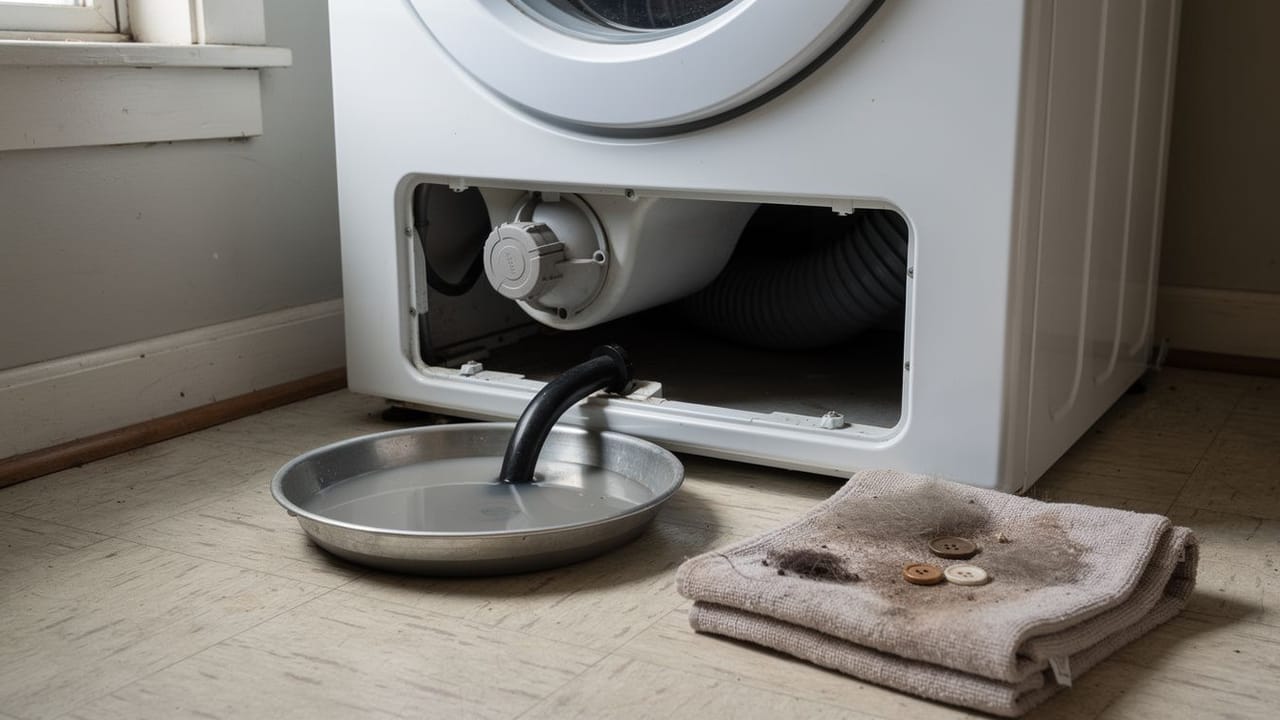
On a front-loader it sits low on the cabinet. Whirlpool’s pump filter instructions say it is typically at the front bottom of the washer, and LG’s guide to cleaning the drain pump filter has you take off an access panel on the lower front left, or the right on some models. LG describes the filter collecting lost buttons, loose change and lint, and notes that its top-loaders do not have one at all.
The makers do not agree on how often to open it: LG recommends once a month, Whirlpool every few months or as needed. If yours has never been opened, start there.
Expect water when you do. Whirlpool has you set a large, flat container under the filter and let the drum empty through the small black drain hose before you unscrew anything, and LG warns that a little more runs out when the filter comes off, so put towels down around the pan.
How do you check the drain hose?
Pull the machine forward and look at the hose behind it. LG’s page on the OE drain error says a washer set too close to the wall can kink or crush its drain hose, and asks for at least 4 inches of space behind the cabinet. The same page lists a frozen drain hose, which is worth remembering for a washer in an unheated garage after a hard freeze.
While you are back there, check how far the hose goes into the standpipe. Whirlpool’s guidance for a washer that keeps filling, or fills and drains at once says the hose should reach no more than 4.5 inches into the drainpipe and needs a gap around it for air, because a hose pushed in too far can siphon water back into the washer. That is a different symptom from a drum left full, but it is an easy fix while the machine is pulled out.
Whirlpool’s troubleshooting guide for a washer that will not drain or spin also asks you to make sure the hose is not clogged. When we suspect the hose, we take it off and look through it.
- Clean the drain pump filter first, over a flat pan with towels down
- Look for a kinked or crushed hose behind the machine
- Leave the hose no more than 4.5 inches into the standpipe, with an air gap around it
- Make sure the door or lid is fully shut and latched
- Note any error code on the display, such as LG’s OE or Samsung’s 5C or 5E
- Listen during the drain part of the cycle and note whether the pump runs
The standpipe
If water comes back up out of the standpipe while the washer is pumping out, the water is leaving the machine and the pipe is not taking it. We check the house drain at that point before we touch the washer, and a blocked drain line is a job for a plumber, not an appliance technician.
Height matters as well. Whirlpool’s front-load drain page gives a standpipe between 30 and 96 inches and says above 96 inches the washer cannot pump the water out properly, while its fill guidance asks for at least 39 inches from the floor, so go by the installation sheet for your own model.
When it is the pump
Before blaming the pump, check the door. Whirlpool’s drain page lists a door that is not closed first, since the lid or door switch only lets the washer operate when it is securely shut.
If the filter is clean, the hose is clear and the drum still will not empty, LG’s own advice is that the unit may need repair service. That is where we test the pump and what drives it, look for anything lodged in the pump housing, and price the repair before any work starts, weighed against the age of the machine the way we set out in our post on when an appliance is worth repairing. If it has reached that point, ask us for an estimate.
Sources
- Samsung, Fix a 5C or 5E error on your washing machine — Blocked filter or kinked drain tube as the most common drain causes; 5C and 5E drain codes
- Whirlpool, Cleaning the Pump Filter - Front Load Washer — Filter typically at the front bottom; clean every few months or as needed; flat container and draining through the small hose first; drawer access on some models
- LG Electronics USA, LG Washer - How to Clean the Drain Pump Filter — Access panel lower front left, right on some models; catches buttons, loose change and lint; clean monthly; shallow pan; no filter on LG top-loaders
- LG Electronics USA, Water Not Draining (OE Error) — Clogged filter, kinked or frozen drain hose; at least 4 inches behind the washer; may need repair service
- Whirlpool, Continuously Fills / Fills and Drains - Front Load Washer — Hose no more than 4.5 inches into the drainpipe; air gap; siphoning; 39-inch minimum drain height
- Whirlpool, Washer Not Draining or Spinning? Troubleshooting Guide — Make sure the drain hose is not kinked or clogged
- Whirlpool, Front Load washer is not Draining, not Spinning, or Leaving Wet Loads — Door not closed and the lid or door switch; standpipe 30 to 96 inches; cannot pump out above 96 inches
FAQ
Why a Washing Machine Will Not Drain — questions
Where is the drain filter on a washing machine?
On front-loaders that have one, it is typically at the bottom front of the cabinet behind an access panel or service cover, on the lower front left on LG models or the right on some, and behind a drawer on some Whirlpool models. Samsung names a blocked filter and a kinked drain hose as the most common reasons a washer will not drain. Let the drum water out through the small drain hose into a flat pan before you unscrew the filter.
Why does water come back up out of the standpipe?
If the water is coming out of the top of the standpipe while the washer pumps out, the machine is emptying and the pipe is not keeping up. We check the house drain before the washer in that case, and a blocked drain line is work for a plumber rather than an appliance technician. Whirlpool also warns that a standpipe taller than 96 inches stops a washer pumping out properly.
Is a drain pump worth replacing?
It depends on the machine, its age and what else is wrong with it, and none of the manufacturers’ help pages put a price on it. We confirm it is the pump first, after the filter, hose and door have been ruled out, then quote the repair before any work starts so you can weigh it against replacing the washer.
Why is my washer still not draining after cleaning the filter?
Look at the drain hose next. LG says a washer pushed too close to the wall can kink or crush it and asks for at least 4 inches behind the cabinet, and a hose can freeze in an unheated garage. Check the door is latched too. If all of that is fine, the pump is the next thing to test.