
· by Michael Blair, Nashville's Appliance Repair
A common rule of thumb says to replace an appliance once the repair costs more than half the price of a new one. It’s a fair place to start, and it skips the question that usually settles the matter, which is what actually failed.
Typical lifespans
The Department of Energy works from average lifetimes when it weighs a new efficiency standard. Its 2023 proposal for refrigerators and freezers uses 14.8 years for a standard-size refrigerator, its 2023 clothes washer proposal uses 13.7 years for a washer, and its dishwasher technical support document puts a dishwasher at 15.2. Ranges aren’t reliably the longest-lived thing in the kitchen: the 2024 cooking products rule in the Federal Register gives 16.8 years for electric cooking appliances and 14.5 for gas.
Those are averages, not expiration dates, but they’re the yardstick we hold a quote against. A fault at year three is a different proposition from the same fault at year twelve, because the older machine has fewer years left to earn back what the repair costs.
Which part failed
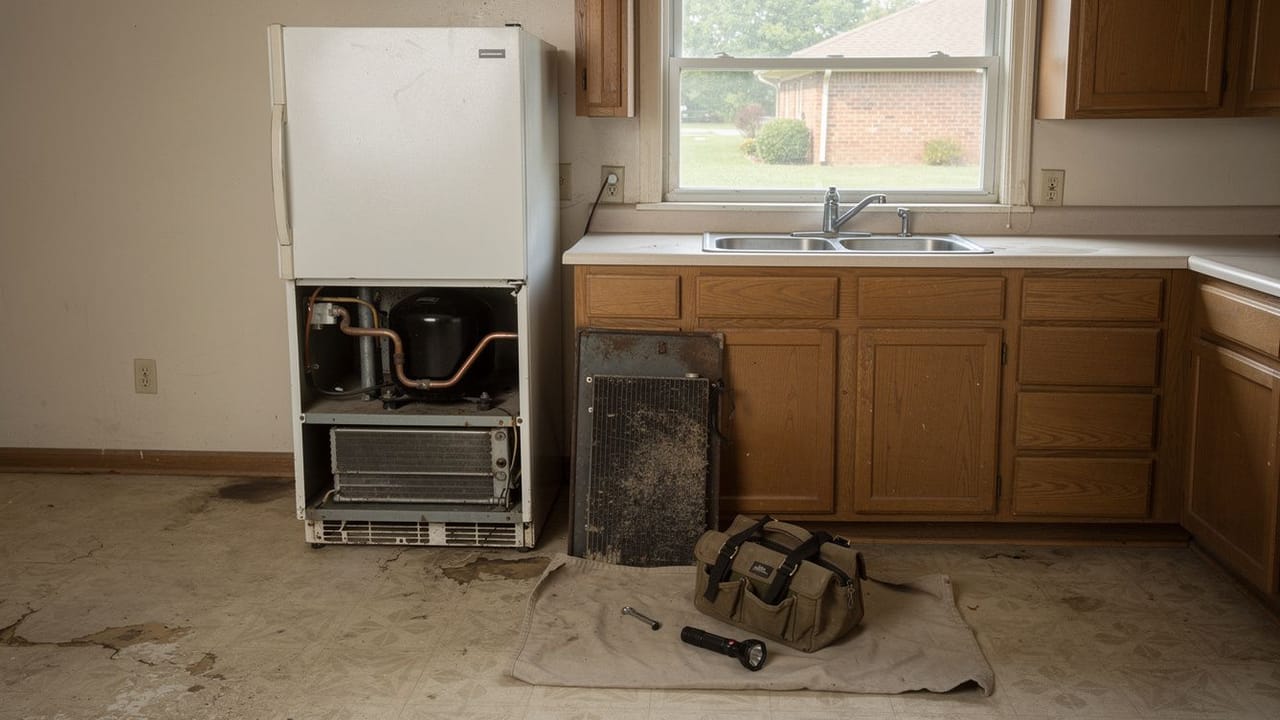
On a refrigerator, the first thing we pin down is whether the fault sits inside the sealed system, meaning the compressor or a refrigerant leak, or outside it in a door gasket, a thermostat or a fan motor. Those are different jobs, so we price the one you actually have rather than quoting a category. Our refrigerator repair page covers that work, and our post on a refrigerator that stops cooling goes through what we check first.
A washer gets the same treatment. Worn bearings or a damaged drum is a different repair from a pump, an inlet valve or a control board, and the part price for your model is what decides it, which is why every washer repair visit of ours starts with the diagnosis.
- Fridge: sealed system (compressor, refrigerant) or a part outside it
- Washer: bearings and drum, or a pump, valve or board
- The part price for your model, not a typical figure
- The repair total against a comparable new machine
- The appliance’s age against its average lifetime
Why get a diagnosis before deciding?
A diagnostic visit gives you the actual fault and the actual part cost instead of a guess. Whether the fee is credited toward the repair differs from company to company, so ask when you book. If you’d like us to look at yours, set up a visit here.
Deciding without it means choosing between an unknown repair and a known replacement, and that tilts people toward throwing out machines that had an inexpensive fault.
Does a new appliance save enough energy to matter?
For an old refrigerator it’s real. ENERGY STAR’s refrigerator page says a refrigerator over 15 years old could be costing about $95 a year more to run, and that an old one uses about 20% more energy than a certified model. That running cost belongs in the replacement case.
For washers and dishwashers it carries less weight. According to ENERGY STAR’s clothes washer page, a certified washer uses about 20% less energy and 30% less water than a regular one and saves about $530 in energy over its lifetime; the gap is wider if the old machine is a top-load agitator, since a certified front loader uses about 50% less energy and water than one of those. ENERGY STAR’s dishwasher page puts a standard-size certified dishwasher at about $50 a year to run and gives no figure for how much more an older one uses, so we don’t treat energy as a reason to retire a dishwasher that can be fixed. If yours is the one in question, our dishwasher repair page covers the faults we see.
Sources
- U.S. Department of Energy, Refrigerators, Refrigerator-Freezers and Freezers energy conservation standards NOPR (2023) — Average lifetime of 14.8 years for standard-size refrigerators
- U.S. Department of Energy, Residential Clothes Washers energy conservation standards NOPR (2023) — Average clothes washer lifetime estimated at 13.7 years
- U.S. Department of Energy, Dishwashers technical support document (2022) — Average dishwasher lifetime of 15.2 years
- Federal Register 2024-02008, Energy Conservation Standards for Consumer Conventional Cooking Products (2024) — Average lifetimes of 16.8 years for electric and 14.5 years for gas cooking products
- ENERGY STAR, Refrigerators — Refrigerators over 15 years old could cost about $95 more a year to run; old models use about 20% more energy than certified ones
- ENERGY STAR, Clothes Washers — Certified washers use about 20% less energy and 30% less water, save about $530 over their life; front loaders use about 50% less than top-load agitator washers
- ENERGY STAR, Dishwashers — A standard-size certified dishwasher costs about $50 a year to run; no old-versus-new comparison given
FAQ
When an Appliance Is Worth Repairing — questions
Is the fifty percent rule a good guide?
It’s a reasonable starting point. If the repair costs more than half the price of a comparable new machine, replacing it is worth pricing. What the rule misses is which part failed and how old the appliance is. A cheap fault on a five-year-old machine is worth fixing, since five years is well short of the average lifetimes the Department of Energy uses for refrigerators, washers and dishwashers.
Should I pay a diagnostic fee?
Generally yes. Some companies credit the fee toward the repair if you go ahead and some don’t, so ask when you book. Without a diagnosis you’re choosing between an unknown repair cost and a known replacement cost, which pushes people toward replacing appliances that turned out to have an inexpensive fault.
Do new appliances really use less energy?
For refrigerators, yes. ENERGY STAR says one over 15 years old could cost about $95 more a year to run, and that is a genuine part of the replacement case. For washers the saving is smaller: ENERGY STAR puts a certified washer at about $530 in energy saved over its whole life. ENERGY STAR gives no old-versus-new figure for dishwashers, so for those energy rarely decides it on its own.
Should I repair or replace my washer?
It turns on what failed and the washer’s age. Worn bearings or a damaged drum are a bigger repair than a pump, inlet valve or control board, and the Department of Energy puts a washer’s average life at 13.7 years. ENERGY STAR’s lifetime saving of about $530 means energy matters less than for an old fridge.