
· by Michael Blair, Nashville's Appliance Repair
A wine cooler looks like a small refrigerator, and people tend to treat it like one: tuck it under a bar, set it in the garage, slide it into an alcove that was built a little too tight. It is less forgiving than a kitchen refrigerator about where it lives, and a lot of the units we are called about for running warm have nothing broken inside them. They are fighting the room. The others have a real fault, a fan, a leak or a compressor, and the difference matters because the second kind is sealed-system work. This is how we sort one from the other when a wine fridge comes through our ice maker, wine fridge and small appliance service, and what you can check before calling.
Where it stands decides most of how it runs
Start with the spot. Danby’s owner’s manual for its DWC134KD1BSS wine cooler is one manufacturer’s manual for one model, but it is unusually blunt: the unit is not designed for outside installation, and it counts anywhere that is not temperature controlled as outside, naming garages, porches and vehicles. The same manual warns against direct sunlight and heat sources such as a stove or heater, and adds that extreme cold can also make the appliance perform improperly. Your model’s manual will have its own wording, and it is worth reading before deciding where the cooler goes.
That condition is hard to meet in a Middle Tennessee garage. The National Weather Service’s Nashville climate records put the normal July high at 90.9°F and the normal July mean at 80.7°F, and those are outdoor readings; an unconditioned garage, a screened porch or a sunroom with west-facing glass can sit near them or above them for weeks. A cooler asked to hold the low fifties in that room runs nearly all the time and may never get there. In January the problem can flip, which is the cold-weather warning in the same manual. So when a cooler kept up in the spring and fell behind in August, the first question we ask, in Hendersonville or anywhere else we work, is where it is plugged in. Our Hendersonville appliance repair page covers the Sumner County side of that work.
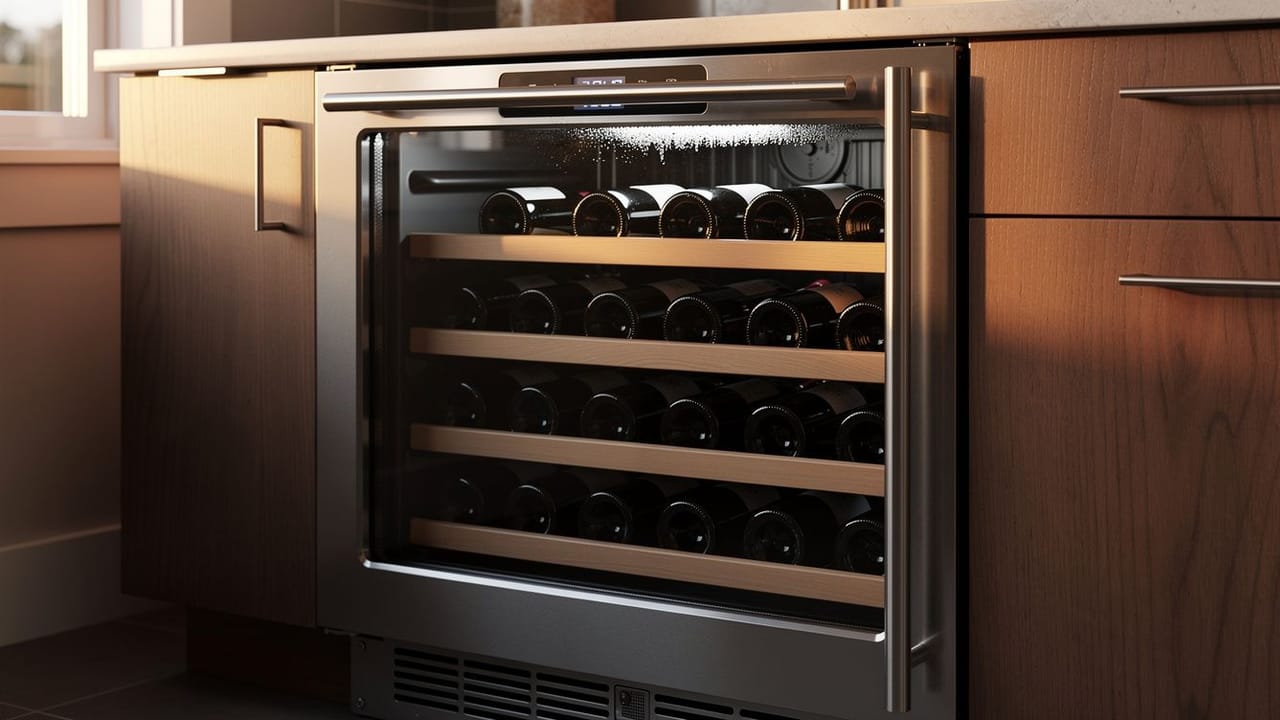
Built-in placement has its own trap. The Danby troubleshooting table lists an obstructed exhaust vent as a cause of warm inside temperatures, and Danby’s support answer below says to make sure there is adequate ventilation around the unit. A freestanding cooler pushed into a cabinet opening, or a front-venting under-counter unit with a trim strip or a rug blocking the grille at the toe kick, is rejecting its heat into a pocket of air it already warmed. Moving it out a few inches or clearing the grille is sometimes the whole repair.
What to check before calling
Danby’s FAQ on a wine cooler that is not cooling properly lists the same first steps we would: confirm it has power, check the thermostat setting, check the door seal, clean the condenser coils and make sure there is room for air to move. The manual’s troubleshooting table for an inside temperature that is not cold enough adds a few more that are easy to overlook.
Two of those are about use rather than parts. The manual says the actual inside temperature varies with the room, with how often the door is opened and with how many warm bottles were just added. A case of wine carried in from a warm car and loaded all at once will pull the display up for hours, and that is the cooler working, not failing. If the cooler was moved lying on its side or back, the same manual says to let it stand upright about six hours before plugging it in, to reduce the risk of a cooling-system malfunction.
Condensation is worth reading too. Beading on the cabinet or the glass door, in that manual, points to a door that is not closing fully, a door opened too often, or a room that is very warm or humid. A glass door that sweats along one edge often means the seal is not meeting the frame on that side.
- Power at the outlet and the setting where you left it
- Door closing fully, with the seal touching the frame all the way around
- Exhaust vent and front grille clear, with room around the cabinet
- Condenser coils free of dust and pet hair
- No stove, heater or afternoon sun on it, and a room that is actually climate controlled
- Warm bottles loaded recently, or the door opened a lot today
Alarms, fans and the parts that do fail
Many coolers will tell you when they are behind. The Danby model in that manual sounds a HI alarm when the cabinet stays above 23°C, about 73°F, for an hour, and a LO alarm below 0°C. Other brands use different thresholds and codes, so check the manual for yours, but a high-temperature alarm that keeps coming back in a room that is comfortable to stand in is a sign something inside has stopped keeping up.
When the room, the vents and the door all check out, the manual’s table names what is left: a possible leak in the system, a failed evaporator fan or a failed compressor. Of those, the fan is the part we can usually test and replace without touching refrigerant. We listen for it, check whether it turns when the cooler calls for cooling, and test the fan and its wiring against the specification for that model. A fan that has stopped leaves cold air sitting around the evaporator while the top racks warm up, which is why the bottles near the evaporator can feel colder than the ones on the upper racks. If the fan runs and the compressor starts but the evaporator never frosts or chills, the trouble is more likely in the sealed system. This is the same line we draw for kitchen units in when a refrigerator stops cooling, with less room to work and smaller parts.
Sealed-system work, and who is allowed to do it
Once the diagnosis points at refrigerant, a leak or a compressor, the work is regulated. The EPA’s Section 608 technician certification requirements count as a technician anyone who attaches hoses and gauges to measure pressure or who adds or removes refrigerant, and there are four certification types, with Type I covering small appliances. The EPA’s Section 608 questions and answers for certified technicians define a small appliance as one fully manufactured, charged and hermetically sealed in a factory with five pounds or less of refrigerant. Which category a given cooler falls in depends on its charge, so that is read off the unit’s own label. Under the EPA’s Section 608 program, venting refrigerant on purpose while servicing or disposing of refrigeration equipment is prohibited.
There is a safety side as well. The Danby model above uses R600a, a flammable refrigerant, and the manual warns not to puncture the refrigerant tubing and says servicing should be done by factory authorized service personnel. Many coolers carry the refrigerant type on the rating label inside the cabinet or on the back. If yours names a flammable refrigerant, that is one more reason not to drill, cut or bend anything near the back panel.
Whether a sealed-system repair is worth it on a cooler is a judgment call, not a rule. A fan, a thermostat or a door seal is a single part and nearly always worth replacing. A compressor or a leak on an inexpensive freestanding unit can cost more than the cooler is worth, while a built-in model sized to a cabinet opening is a different decision, because the replacement has to fit the hole. We tell you which side of that line your unit is on before any work starts. If yours is running warm, send the model number from the rating label through our free estimate request and say where the cooler is installed; that one detail answers a lot.
Sources
- Danby: Wine Cooler Owner’s Manual, model DWC134KD1BSS (2019) — Not for garages, porches or other places that are not temperature controlled; vents, heat sources, cold rooms; six-hour upright wait; HI/LO alarms; troubleshooting table; R600a and factory-authorized service.
- Danby: The Wine Cooler Is Not Cooling Properly — Check power, thermostat and door seal; clean the condenser coils; allow ventilation around the unit.
- U.S. EPA: Section 608 Technician Certification Requirements — Who counts as a technician; four certification types, Type I for small appliances.
- U.S. EPA: Questions and Answers for Section 608 Certified Technicians — Small appliance: factory sealed with five pounds or less of refrigerant.
- U.S. EPA: Stationary Refrigeration and Air Conditioning (Section 608) — Intentional venting of refrigerants during service or disposal is prohibited.
- National Weather Service Nashville: Climate Records — Nashville normal July high 90.9°F, normal July mean 80.7°F.