
· by Michael Blair, Nashville's Appliance Repair
An oven that will not hold temperature shows up in the food first: a cake that sinks in the middle, a roast that needs an extra half hour, one sheet of biscuits browned and the next still pale. Sometimes the oven is fine and the dial is simply being read too literally, because every oven cycles above and below its setting. Other times a part is failing, and it is usually one of four: the bake element on an electric oven, the igniter on a gas oven, the temperature sensor, or the door gasket that keeps the heat in. The way to tell which is to measure before replacing anything, and that measuring is the first half hour of every visit our oven and range repair service makes.
Measure it before you blame it
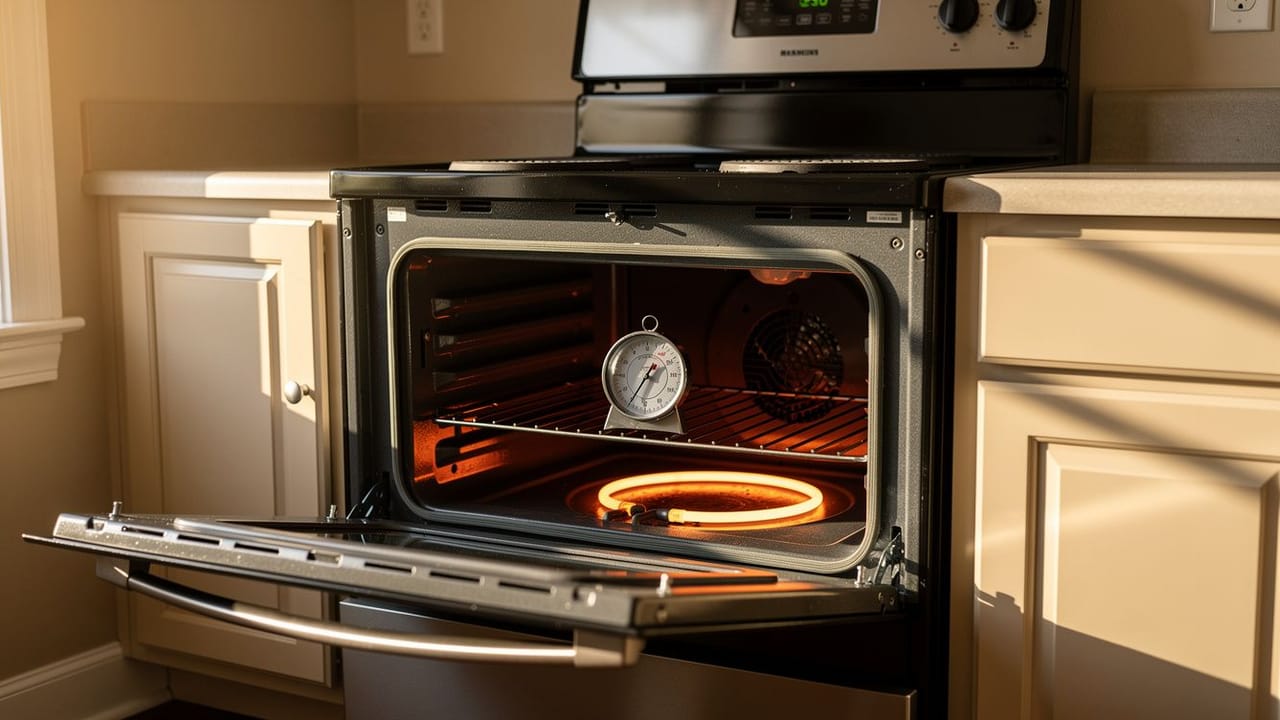
The dial and the display only tell you what the control is aiming for. To see what the oven is actually doing, put an inexpensive oven thermometer in the center of the middle rack, set the oven to 350, and let it run well past the preheat signal before reading anything. Then read it several times over the next twenty minutes through the window, without opening the door, and average what you see. A single reading means very little, because the oven is built to overshoot and fall back.
How much swing is normal is answered plainly in GE Appliances’ guide to oven temperature that is not correct: temperatures can run 30 degrees above or 30 degrees below the setting in most cases, a total swing of 60 degrees, and the goal is to hold the average. Wolf’s answer on oven temperature says the same thing without a number, that ovens heat past the set temperature and then turn off, and that the fluctuation is normal. So a thermometer that reads 330 at one moment and 370 at the next, averaging near 350, is an oven doing its job. An average that sits well away from the setting, or an oven that never climbs close to it, is a fault.
Two things to rule out first cost nothing. GE’s same page notes that racks installed backward can keep the door from sealing. And on a gas oven, take out any foil lining the oven floor: the Consumer Product Safety Commission’s carbon monoxide guidance says not to cover the bottom of a natural gas or propane oven with foil, because it blocks the combustion airflow and can produce carbon monoxide.
- Thermometer in the center of the middle rack
- Oven set to 350 and left well past the preheat signal
- Several readings over twenty minutes, door closed
- Judge the average, not the highest or lowest reading
Bake elements on electric ovens, igniters on gas
On an electric oven the bake element does most of the work, from under the oven floor or exposed along the bottom of the cavity. It usually fails by burning through: a blister, a split or a spot that flares bright while it heats and then goes dark for good. With the bake element out, the broil element at the top is still cycling, so the oven creeps up to temperature slowly, browns the tops of things and leaves the bottoms underdone. We check the element with a meter at its terminals and look at the terminals and wiring behind it, which can scorch along with the element and need replacing at the same time.
A gas oven depends on its igniter. LG’s help page for gas ovens that will not heat describes the igniter glowing red and lighting the burner in about 30 to 60 seconds, and states that if the igniter is not working the oven will not heat, and that the gas valve must open for it to heat. On most ovens with a glow-bar igniter, the valve opens only when the igniter is drawing enough current. As an igniter ages it keeps glowing but draws less, so the valve opens late or not at all. That is why a weak igniter is so easy to miss: it looks like it is working, the oven just lights later and later, falls behind on each cycle, and the average temperature sags. We measure the igniter against the specification for that oven rather than judging it by its glow.
The temperature sensor, and when calibration is the answer
An electronic oven reads its cavity through a sensor probe, usually a thin rod on the back wall near the top. Its resistance rises as it heats, and the control turns that resistance into a temperature. Frigidaire’s service data sheet for electric ranges with electronic oven controls lists 1091 ohms at 75°F, room temperature, rising to roughly 1654 ohms at 350°F. That figure belongs to that sensor; it varies by brand and sensor type, so we test against the sheet for the oven in front of us. A sensor that reads wrong makes the control hold the wrong temperature with complete confidence, and a pinched harness or a loose connector behind the back panel produces readings that jump around.
When the element or igniter tests good, the sensor tests good, and the oven is off by a steady amount every time, calibration is the fix. GE’s oven calibration instructions let the set temperature be raised or lowered by up to 35 degrees from the control menu; the change does not touch broil or self-clean temperatures and stays in memory through a power failure. Whirlpool’s calibration page allows 30 degrees either way, in 5-degree steps on some models and 10-degree steps on others, and the method depends on the model. Frigidaire’s article on an oven that is not hot enough points owners to the Use and Care manual for the same adjustment.
An offset is meant for an oven that is consistently off. It will not fix one that swings wider than normal or drifts from week to week, and dialing one in to cover a failing sensor only buys time until the offset runs out. When the parts above all test good and the problem remains, we test the control board and, on a convection model, the fan, before naming a part.
The door gasket, and whether the repair is worth it
The gasket is the woven or rubber seal around the oven opening. Frigidaire’s article above says heat loss can happen if the gasket is torn, worn, detached or missing, and that the woven material is essential for trapping heat in the cavity; GE’s page says to look for rips or tears. With the oven cold, run a finger around it and look for flattened stretches, gaps at the corners and clips pulled out of their holes. With the oven hot, heat you can feel at the edge of the door or on the cabinet beside it is heat the oven is losing. On many ovens the gasket clips into the frame and is a straightforward swap; on others it is part of the door assembly.
Whether to repair or replace is our judgment, not a rule. An element, an igniter, a sensor or a gasket is a single part on almost any range, and on a range that otherwise works it is nearly always worth replacing. The math changes on an older range when the control board is failing, the porcelain in the cavity is chipping, or two or three things are going at once. We walk through how we weigh that in when an appliance is worth repairing, and we will say plainly which side of that line your oven is on when we look at it.
Sources
- GE Appliances: Oven Temperature Is Not Correct — Normal swing of 30 degrees above or below the setting; racks and door gasket.
- GE Appliances: Oven Calibration — Set temperature adjustable up to 35 degrees; does not affect broil or self-clean; kept after a power failure.
- Whirlpool: How to Calibrate the Oven — Adjustment of 30 degrees either way, in 5- or 10-degree steps by model.
- Frigidaire: Oven Is Not Hot Enough — Torn, worn, detached or missing door gasket causes heat loss; calibration in the Use and Care manual.
- Frigidaire Service Data Sheet, Electric Ranges with Electronic Oven Controls — Oven sensor resistance: 1091 ohms at 75°F, about 1654 ohms at 350°F.
- LG: Oven Not Heating, Gas Ranges — Igniter glows and lights in about 30 to 60 seconds; the oven will not heat without it.
- Wolf: Oven Temperature Issue — Ovens heat above the set temperature and then turn off; fluctuation is normal.
- U.S. Consumer Product Safety Commission: Carbon Monoxide Questions and Answers — Do not cover the bottom of a gas oven with foil; it blocks combustion airflow and can produce carbon monoxide.