
· by Michael Blair, Nashville's Appliance Repair
A dryer that used to finish a load in one cycle and now needs two is one we check for airflow before we go anywhere near the heating element. The Consumer Product Safety Commission’s dryer fire alert says clothes still damp at the end of a typical cycle, or drying that takes longer than normal, may be a sign that the lint screen or the exhaust duct is blocked. That is why the vent is the first thing we look at on a dryer repair call, before we price a single part. It matters for more than the power bill, because the lint that slows a dryer down is also what the fire numbers further down this page are about.
How does a dryer actually dry clothes?
The U.S. Fire Administration’s report on clothes dryer fires describes it plainly: a dryer forces hot air through a turning drum, and the moving hot air dries the clothes. That air leaves carrying moisture and lint, and the building codes the report summarizes require it to be exhausted directly to the outdoors. Heat without that flow does very little. A dryer with a perfectly good element and a choked vent will keep tumbling warm, wet towels.
The symptoms come from the air too. Damp clothes after a full cycle and cycles that keep stretching out are the two the CPSC names. The Building America Solution Center’s guide to cleaning a dryer exhaust, published by the Department of Energy’s Pacific Northwest National Laboratory, adds that lint built up in the vent blocks air leaving the dryer, which increases drying times and can cause the dryer to overheat. A machine that runs hot and still dries slowly is the pattern that sends us to the vent first.
Where the restriction is, in order of likelihood
We start with the lint screen because it takes a minute to rule out. Peeling the lint off is the part everyone does, and the CPSC says to clean the screen before or after each load. Scrubbing the mesh is the part most people skip. The USFA report recommends cleaning the filter with a nylon brush at least every six months, or more often if it becomes clogged.
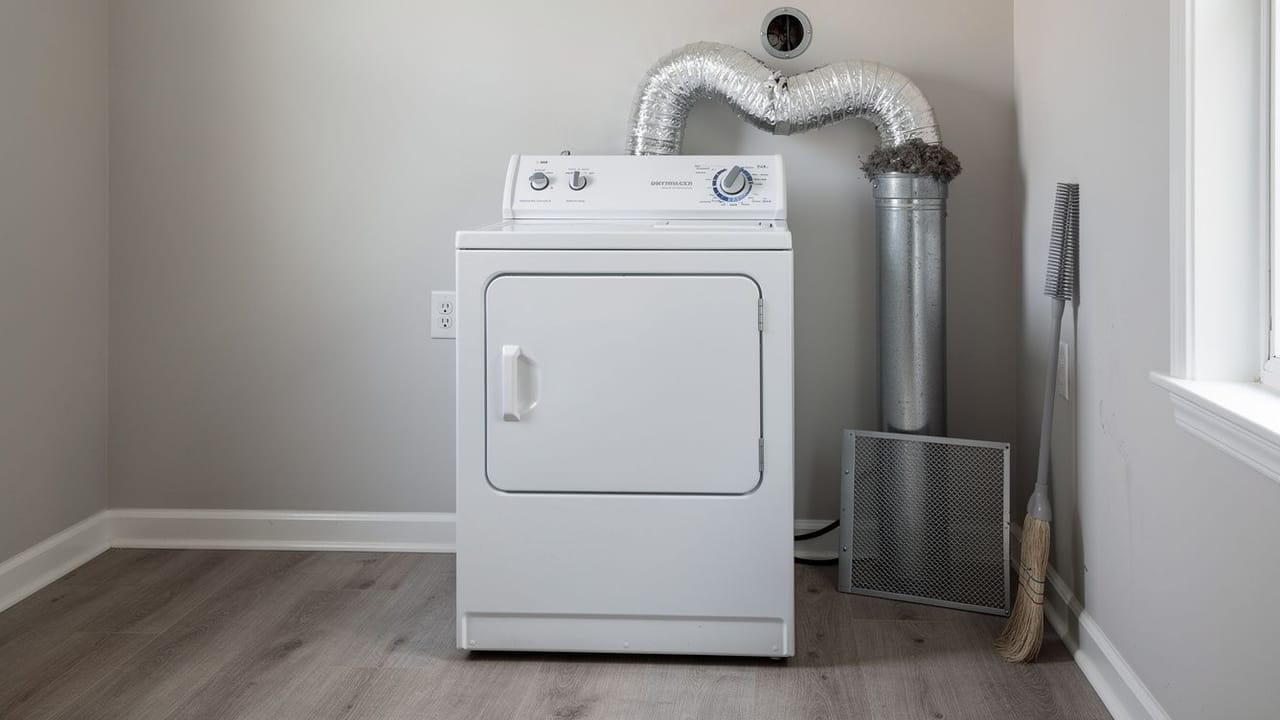
Then the duct, from the back of the machine to the hood on the outside wall. The USFA explains why long runs give trouble: when a vent is too long or has many bends and turns, moisture in the warm air condenses on the duct walls and attracts lint. The CPSC alert adds that flexible plastic or foil duct traps lint more easily and is more prone to kinks and crushing, which can greatly reduce airflow. The USFA’s checklist says to inspect the venting behind the dryer for damage, crushing or restriction, so pull the machine out and look at those first few feet.
Then the hood outside. The USFA notes that vents also get blocked by the nests of small birds or other animals, and says to make sure the outdoor vent covering opens when the dryer is operating. The CPSC’s test is simple: with the dryer running, go outside and check that exhaust air is escaping. If it is not, the vent or the duct may be blocked. A wire screen or cloth tied over the hood is a problem of its own, because the USFA warns that those collect lint and clog the vent. The vent is one item on our list of appliance maintenance worth doing, and it is the one with the most riding on it.
- Scrub the lint screen with a nylon brush every six months, beyond pulling the lint off
- With the dryer running, check that the outside flap opens and air comes out
- Replace plastic or foil accordion duct with rigid or semi-rigid metal
- Pull the machine out and check the duct behind it is not crushed or kinked
- Clean the full duct run once a year, and sooner when loads start taking longer
Why is lint in a dryer vent a fire risk?
The USFA calls lint a highly combustible material that builds up both in the dryer and in the vent, and says the reduced airflow from that buildup can keep a dryer from running efficiently and possibly make it overheat. In the residential dryer fires it studied from 2008 to 2010, failure to clean was the leading specific factor contributing to ignition, at 34 percent. NFPA’s Home Dryer Fires report found the same pattern in 2014 to 2018 data: fire departments responded to an estimated 13,820 home structure fires a year in which dryers were involved, and 32 percent of dryer fires were caused by a failure to clean.
A gas dryer adds a second concern. HUD’s inspection standard for clothes dryer exhaust ventilation says the vent is there to remove combustion gases, including carbon monoxide, along with heated air, moisture and lint, and in the housing HUD inspects it rates a blocked or damaged gas dryer vent as life-threatening, to be corrected within 24 hours. The Tennessee Department of Health’s Healthy Homes page also advises having a gas dryer inspected by a professional so the gas line and connection are intact and free of leaks, and it says to clean lint out of the vent pipe once a year, or sooner if clothes start taking longer than normal to dry. A dryer that has slowed down is worth dealing with soon, and on a gas machine we would not wait.
When it really is the machine
If the vent is clear, the flap opens and the dryer still will not dry, then we move to the machine. On an electric dryer we test the heating element and the thermal fuse, on a gas dryer the igniter and the gas valve, and on either one the blower that moves the air. When we find a blown thermal fuse, we clear and check the duct before fitting a new one. The Solution Center guide ties a lint-blocked vent to overheating, and we would rather fix the cause than only the part.
A drum that turns while the air stays cold is a different complaint from the slow-drying one, and that is when we start on the heating side instead of the vent. If the duct turns out to need replacing rather than cleaning, the new run has to meet code. Metro Nashville’s adopted codes list shows the 2024 International Residential Code and International Mechanical Code in force with local amendments. As the USFA summarized the model codes, the duct is metal with a smooth interior, its sections supported and sealed, and its total length no more than 35 feet, shorter where there are turns or bends.
We repair dryers across Nashville and Davidson County and the towns around it. If yours has started asking for a second cycle, send us the make, whether it runs on gas or electric, and how long a load takes now, and we will start with the air.
Sources
- U.S. Consumer Product Safety Commission, Overheated Clothes Dryers Can Cause Fires (Pub. 5022) — Damp clothes or longer drying may be a sign of a blocked lint screen or exhaust duct; clean the screen before or after each load; check that exhaust air escapes outside; plastic or foil duct kinks and crushes; replace it with rigid or corrugated semi-rigid metal
- U.S. Fire Administration, Clothes Dryer Fires in Residential Buildings (2008-2010), Topical Fire Report Series vol. 13 issue 7, 2012 — How a dryer dries; lint is highly combustible; failure to clean the leading factor at 34 percent; long runs and bends collect lint; nests block vents; nylon brush every six months; check the duct behind the dryer; no wire screen or cloth on the hood; codes require exhaust outdoors, metal duct, 35-foot limit, transition duct rules; manufacturers say not to use plastic flexible duct
- NFPA Research, Home Dryer Fires (M. Ahrens, June 2020) — An estimated 13,820 home structure fires a year involved dryers in 2014-2018; 32 percent caused by a failure to clean
- HUD, NSPIRE Standard: Clothes Dryer Exhaust Ventilation, v2.2 (2022) — The vent removes combustion gases including carbon monoxide, heated air, moisture and lint; a blocked or damaged gas dryer vent is life-threatening with a 24-hour correction timeframe
- Building America Solution Center (U.S. DOE, PNNL), Clean Dryer Exhaust — Lint in the vent blocks airflow, increases drying times and can make the dryer overheat; clean the duct annually
- Tennessee Department of Health, Healthy Homes: Clothes Dryer Safety Tips — Clean lint out of the vent pipe once a year or sooner if drying slows; have a gas dryer’s line and connection inspected by a professional
- Metro Nashville Codes Administration, Adopted Codes List — The 2024 International Residential Code and International Mechanical Code adopted with local amendments in Nashville
FAQ
Why a Dryer Takes Two Cycles to Dry — questions
How often should a dryer vent be cleaned?
Once a year is the usual advice from the Tennessee Department of Health and the Building America Solution Center, and the health department says to do it sooner if clothes start taking longer than normal to dry. A long run or one with several bends deserves closer watching, because the U.S. Fire Administration notes that moisture condenses in those runs and attracts lint.
Is flexible foil dryer duct allowed?
Plastic flexible duct should not be used at all; the U.S. Fire Administration says all manufacturers now state in their manuals not to use it between the vent and the dryer, and it calls flexible foil not a good choice either. The CPSC advises replacing plastic or foil accordion duct with rigid or corrugated semi-rigid metal. Under the model codes the USFA summarized, a flexible transition duct at the connection must be listed to UL 2158A, no longer than eight feet and not concealed inside the construction.
Can a dryer vent into the garage or crawl space?
No. The U.S. Fire Administration’s summary of the building codes says dryers must be exhausted directly to the outdoors and that venting into attics, soffits, ridge vents or crawl spaces is expressly prohibited, and a garage is not outdoors. The vent carries heated air, moisture and lint out of the house, so it should end at an outside hood that opens when the dryer runs, with no wire screen or cloth over it to catch lint.
Why is my dryer not drying after cleaning the vent?
If the vent is clear and the outside flap opens, the machine itself is next. On an electric dryer we test the heating element and the thermal fuse, on a gas dryer the igniter and gas valve, and on either the blower. Scrub the lint screen with a nylon brush too, which USFA advises every six months.