
· by Michael Blair, Nashville's Appliance Repair
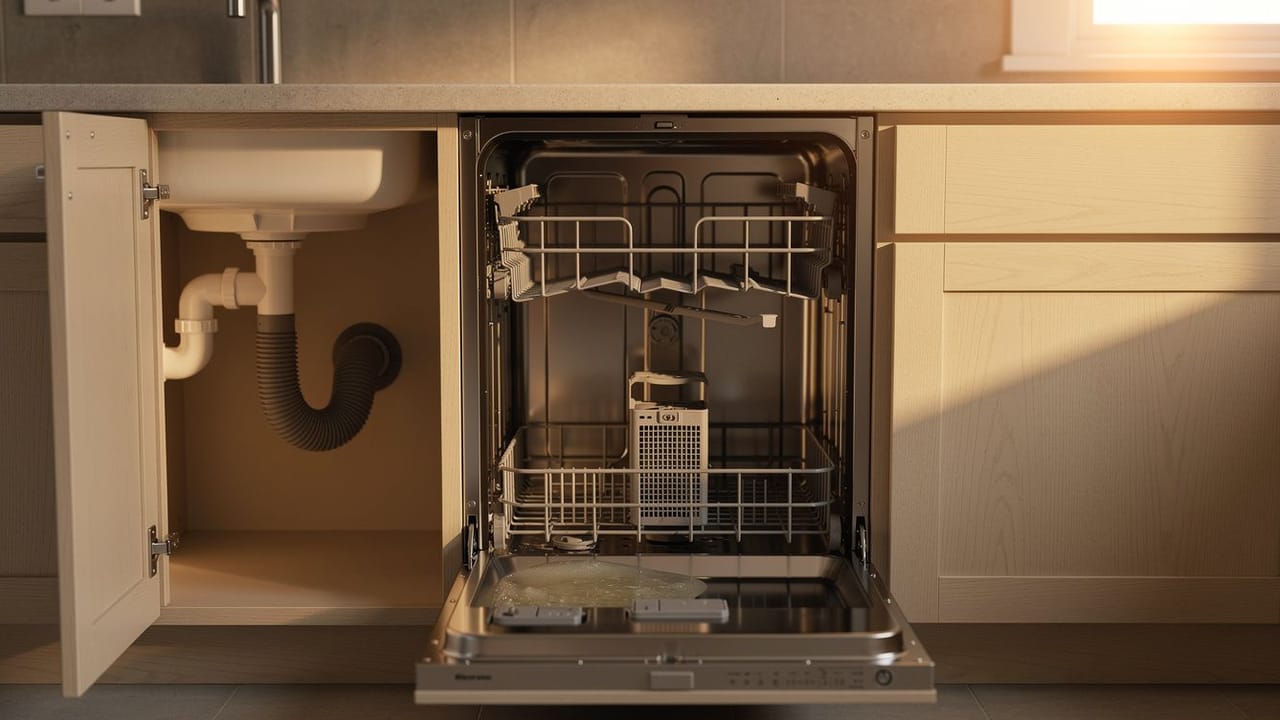
A dishwasher that leaves water in the bottom gets noticed at the worst time, usually right after the biggest load of the year. Open the door, and there is a gray pool around the filter and a smell to go with it.
The list of causes is short, and the first few take no tools. Some of them are not in the dishwasher at all but under the sink, in the hose, the air gap or the disposal it drains through. Here is what is normal, what to check and in what order, and what points to a part that has to be replaced.
How much water in the bottom of a dishwasher is normal?
A small amount of clean water down in the sump is normal; dirty water spread across the floor of the tub is not. GE’s page on water in the bottom of the tub says one to two cups of standing water is expected. Its dishwasher not draining page adds a model difference: on machines with an ultra fine filter, water in the sump is fine, but it should not cover the tub floor.
Two other signs matter. Water that is clean after a cycle usually just did not pump out at the end. Water that is dirty and builds up over several days points to the drain path, and GE ties that pattern to a missing air gap or a missing high loop, which lets sink water run back into the dishwasher.
Before checking anything, make sure the cycle really finished. A door opened partway through, or a power blip, can leave the final drain undone, and the water you see is simply the last fill.
What are the most common reasons a dishwasher will not drain?
A clogged filter or debris in the sump comes first. Whirlpool’s dishwasher not draining page lists a clogged filter, sump debris, a jammed drain pump, a kinked or blocked hose and trouble at the disposal or sink connection as the frequent causes. Our post on a dishwasher that stops cleaning shows where the filter is and how it comes out.
Next, the sink side. If there is a disposal, run it before starting the dishwasher to clear what is sitting in it, and clear any clog in the kitchen drain. GE warns never to reach into a disposal by hand. If the sink has an air gap, the small chrome cap beside the faucet, pull the cap and clean out the debris.
Then the suds. GE notes that the wrong detergent or too much of it can foam enough to keep the machine from draining. And GE says not to pour drain cleaner into a dishwasher.
Why won’t a dishwasher drain after a new garbage disposal goes in?
Usually because the knockout plug is still in the disposal’s dishwasher inlet. A new disposal ships with that inlet sealed by a plastic plug, which is knocked out only when a dishwasher is connected. Whirlpool’s page on a newly installed dishwasher that will not drain calls removing it critical and says a plug left in place is often mistaken for a clogged machine.
The same page covers the hose. It has to have a proper high loop or run through an air gap, as local code requires, and a hose sitting too low or kinked behind the machine can let water flow back into the tub. GE’s page puts the high loop at a minimum of 32 inches above the floor, fastened to the underside of the counter.
Tennessee’s adopted plumbing rules agree on the routing. The 2018 International Residential Code as adopted in Tennessee, Section P2717.2, has the discharge hose rise to the underside of the counter and be held there before it connects to the disposal or to a wye in the sink tailpiece.
When is it the drain pump?
When the filter, sump, hose, air gap and disposal are all clear and the water still sits there. Whirlpool lists a jammed drain pump among the frequent causes and links a grinding noise to something hard, such as a piece of glass, caught in the pump. A pump that hums and moves no water, or makes no sound at the end of the cycle, is the other pattern we see.
Getting to the pump means pulling the machine out or taking the base apart, depending on the model, with the power off at the breaker and the water shut off. A pump that is only jammed can sometimes be cleared. One with a failed motor gets replaced, and on some models the control that runs it is the part at fault.
That is the point where our dishwasher repair visit starts. We confirm the drain path is clear, test the pump and its control, and replace what failed. If yours in Mount Juliet or anywhere around Nashville is still holding water after the checks above, book a visit.
Sources
- GE Appliances, Dishwasher - Not Draining — Normal water by filter type; filters, sump, hose, sink drain, disposer, air gap and disposer drain plug; detergent over-sudsing; no drain cleaner
- GE Appliances, Dishwasher - Water in the Bottom of the Tub — One to two cups of standing water normal; high drain loop at least 32 inches above the floor; sink water backflow without an air gap or high loop
- Whirlpool Product Help, Dishwasher Not Draining — Frequent causes: clogged filter, sump debris, jammed drain pump, kinked hose, disposal or sink connection; grinding noise from hard debris in the pump
- Whirlpool Product Help, Newly Installed Dishwasher Not Draining — Disposer knockout plug; high loop or air gap per local code; a low or kinked hose lets water flow back into the tub
- International Residential Code 2018, Sections P2716 and P2717 (Tennessee state-adopted edition, UpCodes) — Dishwasher discharge rises to the underside of the counter and is held there before connecting to the disposer or a sink tailpiece wye
FAQ
Dishwasher Not Draining: Water Left in the Bottom — questions
Why is my dishwasher not draining completely?
Most often a clogged filter or debris in the sump. After that, check the sink drain and disposal, the air gap cap if there is one, and the drain hose for kinks or a missing high loop. Too much detergent can foam enough to stop the drain. If all of that is clear, the drain pump is next.
Can I use drain cleaner in a dishwasher?
No. GE’s support page says not to use drain cleaner in a dishwasher. Clean the filter, clear the sump and the sink drain, and run the disposal instead. If the water still will not go down, the problem is the hose, the air gap, the disposal inlet or the drain pump, none of which a chemical fixes.
How high should a dishwasher drain loop be?
GE’s support page calls for the high loop to be at least 32 inches above the floor, with the hose fastened to the underside of the countertop. Tennessee’s adopted residential code has the discharge hose rise to the underside of the counter before it connects to the disposal or sink tailpiece. Your installation manual has the model’s exact figure.
What is the air gap by the kitchen faucet for?
It keeps dirty sink water from flowing back into the dishwasher. The dishwasher drains up through it and back down to the disposal or sink drain. GE notes that without an air gap or a high drain loop, sink water can run into the machine. If the cap leaks during draining, clean out the debris inside.