
· by Michael Blair, Nashville's Appliance Repair
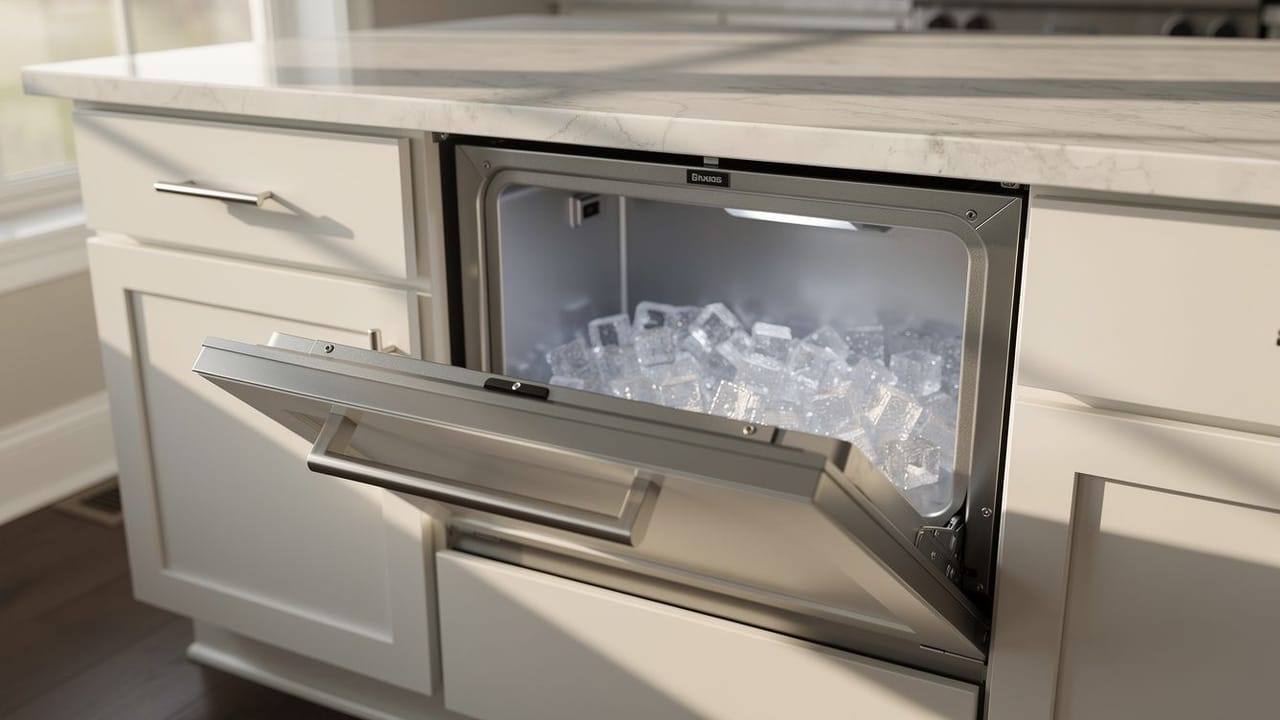
An ice machine under the bar or a nugget ice maker on the counter is not the same thing as the ice maker inside a refrigerator. It has its own condenser fan, its own water reservoir or supply, its own drain and its own cleaning cycle, and it fails in its own ways. If the trouble is the ice maker in your refrigerator’s freezer, our post on a refrigerator ice maker that stops is the one to read.
For the standalone machines, the makers’ own troubleshooting points to airflow, mineral scale and water, usually in that order. Most of the first checks need nothing more than a flashlight and the owner’s manual.
Why does a standalone ice maker stop making ice?
A standalone ice maker most often stops because it cannot get rid of heat. Every ice maker pulls heat out of water and has to push that heat into the room through vents. On its countertop nugget machine, GE puts it plainly in its Opal ice maker troubleshooting page: when the machine is not making ice, blocked air vents are highly likely. GE asks for at least 3 inches of clearance at the back and sides, and for the side water tank to be pulled forward so it does not cover a vent.
The same page notes a behavior that looks like a failure and is not. If no one dispenses ice from that machine for 8 hours, it stops running until someone does. A countertop machine pushed into a corner between a coffee maker and the backsplash, or one that sat untouched over a long weekend, may be doing exactly what it was designed to do.
Undercounter machines vent through the grille at the toe kick. Rugs, a trash can or a dog bed in front of that grille do the same thing as a crowded counter, and lint on the condenser behind it builds up the same way it does under a refrigerator.
How often should a countertop or undercounter ice maker be descaled?
An undercounter ice maker should be cleaned on the maker’s schedule, and sooner where the water is hard. KitchenAid’s page on the cleaning light on its freestanding ice makers says to run the cleaning cycle when the cleaning light comes on, after 9 months, or when ice production drops off noticeably, and as often as every 6 months with harder water. It explains why: as the water freezes, the minerals in it are left behind and build a hard, scaly deposit in the water system. The cycle takes roughly 70 to 90 minutes, and if it is interrupted, pressing Clean picks it up again.
Our water is not soft. Metro Water Services’ 2025 Water Quality Report lists calcium hardness averaging 75.3 mg/L, ranging from 63.9 to 92.6. Homes outside Metro’s service area get their water from other utilities, with numbers of their own, and a well is another matter again. Either way, every gallon an ice maker freezes leaves something behind, which is why a machine that has never been cleaned is the first thing we ask about.
What does an Add Water light mean when the tank is full?
An Add Water light with water in the tank usually means scale or trapped air is keeping water from reaching the machine. For its nugget maker, GE’s troubleshooting page says that when the Add Water alert shows with water present, the fix is to descale it with the 18-hour soak and full rinse described in the owner’s manual.
If water still will not flow from the side tank, GE points to the tube that joins the tank to the machine. Air bubbles caught in that tube can stop the flow, and the tube should lie flat. Lifting the side tank off its base and setting it back in place can clear the trapped air.
A schedule can fool people too. GE’s note on an Opal that does not make ice on schedule says the machine does not know when daylight saving time begins or ends, so a schedule set in the app has to be changed by hand. In the weeks after the clocks change, that is worth checking before anything else.
When cleaning does not bring it back
When a machine has clear vents, a fresh cleaning and water reaching it, and still makes little or no ice, the cause is usually inside. On a service call for ice maker and wine fridge repair, we follow the water through the machine: the inlet valve, the pump that circulates water over the evaporator, the drain and any drain pump, and the bin sensor that tells the machine when to stop. A kinked drain line or a failed drain pump on an undercounter unit can stop production as surely as a bad valve.
Then we check whether the refrigeration side is actually cold. A condenser fan that has stopped, or a sealed system that has lost charge, leaves a machine that runs and never freezes, and those repairs cost more than a cleaning. On a countertop unit, that is often the point where replacing it makes more sense than repairing it, and we will say so.
We work on built-in and countertop ice machines across the area, including appliance repair in Murfreesboro and the towns around it. If yours has slowed down or stopped, send us the make and model and what it is doing, and we will tell you what we would check first.
Sources
- GE Appliances, GE Profile Opal Ice Maker Dispenser troubleshooting — Blocked air vents as the likely cause of no ice; 3 inches of clearance at back and sides; the side tank must not block a vent; no running after 8 hours without dispensing; Add Water alert with water present answered by an 18-hour descale soak and full rinse; trapped air in the side tank tube.
- GE Appliances, Opal Ice Maker not making ice on schedule — The Opal does not adjust for daylight saving time; the schedule has to be changed by hand.
- KitchenAid, Cleaning Light Blinking, Freestanding Ice Maker — Clean when the light comes on, after 9 months or when production drops; as often as every 6 months with harder water; minerals form a scaly deposit; the cycle takes about 70 to 90 minutes.
- Metro Water Services, 2025 Water Quality Report — Calcium hardness averaging 75.3 mg/L, range 63.9 to 92.6 mg/L.
FAQ
Why a Standalone Ice Maker Stops Making Ice — questions
Why is my undercounter ice maker not making ice?
Start with airflow and cleaning. Undercounter machines vent at the toe kick, so anything blocking that grille or lint on the condenser can stop ice production. KitchenAid also lists a noticeable drop in ice as a reason to run its cleaning cycle, which removes the mineral scale that builds up as water freezes.
Why is my nugget ice maker not making ice?
GE says blocked air vents are the most likely reason its countertop nugget maker makes no ice, and it asks for at least 3 inches of clearance at the back and sides. The machine also stops running when no one dispenses ice for 8 hours, which can look like a failure.
How often should you clean an ice maker?
For its freestanding ice makers, KitchenAid says to clean when the cleaning light comes on, after 9 months, or when production drops noticeably, and as often as every 6 months with harder water. Your own model’s manual has the schedule and the cleaner the maker wants used.
Does hard water affect an ice maker?
Yes. KitchenAid explains that minerals left behind as water freezes build a hard, scaly deposit in the water system, which is what its cleaning cycle removes. Metro Water Services reports calcium hardness averaging 75.3 mg/L, so a machine on Nashville water collects scale and needs cleaning on schedule.
How long does an ice maker cleaning cycle take?
On KitchenAid freestanding ice makers the cleaning cycle takes roughly 70 to 90 minutes, and pressing Clean resumes it if it is interrupted. GE’s nugget maker is different: its descaling uses an 18-hour soak followed by a full rinse cycle, as set out in the owner’s manual.