
· by Michael Blair, Nashville's Appliance Repair
When a dishwasher stops getting the dishes clean, we look at the maintenance causes before we go looking for a failed part: the filter, the spray arms, the water coming in and the minerals carried in it. For homes on Metro water in Nashville, Metro Water Services’ 2025 water quality report puts calcium hardness at 75.3 milligrams per liter, within a range of 63.9 to 92.6. That sits in the band the USGS Water Science School classes as moderately hard, which is enough to leave spots and film over time. If your water comes from another utility or a private well, your number will be different.
Where is the dishwasher filter?
Most dishwashers have a filter at the bottom of the tub. Whirlpool’s guide to cleaning dishwasher filters explains that the lower filter keeps food from being recirculated onto your dishes, and that food and debris collect on it over time until it clogs and the cycles stop cleaning. The signs it lists are dishes coming out dirty or gritty, odors, and soil you can see on the filter. Some machines have a self-cleaning filter instead of one you clean by hand, so find out which kind yours has before you go hunting for it.
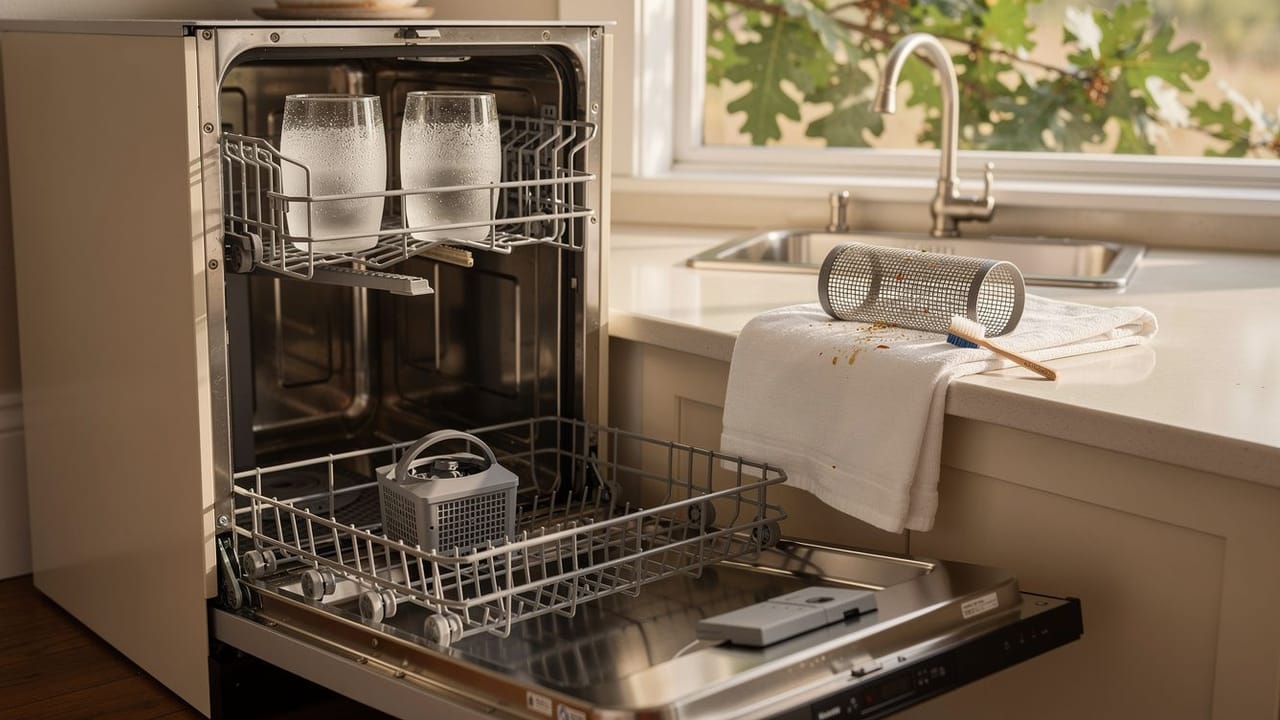
Whirlpool’s general rule is to clean a manual filter once a month, or every two weeks in a large household or with daily use. On the Whirlpool models that page covers, the upper assembly comes out with a quarter turn counterclockwise and the lower filter lifts and slides forward; other brands come apart differently, and your owner’s manual shows how. Rinse it under warm water and work the crevices with a small soft brush, such as an old toothbrush, and keep wire brushes and scouring pads away from it. The filter is one of the jobs on our list of appliance maintenance worth doing, along with the rest of the upkeep that saves a service call.
Spray arms
An arm that cannot spray or cannot turn holds up the whole wash. Whirlpool’s page on food residue left on dishes says a blocked spray arm delays detergent and soil removal, and that when the delay runs long, residue stays in the wash and the final rinse cannot do its best. When we open up a dishwasher that has stopped cleaning, the spray holes are one of the first things we look at. If yours look plugged with food or mineral, take the arms off the way your owner’s manual describes and clear the holes before you put them back.
Loading can stop an arm just as well. Before a cycle, Whirlpool suggests spinning the middle spray arm by hand and rearranging the dishes if anything catches it, and a tall pan or a cutting board standing in an arm’s path is something to fix in the loading, with no part involved. The same page says overloading restricts water circulation and leaves dishes dirty, and it recommends angling dishes with the soiled side facing down and in toward the spray arms. Scrape plates, but there is no need to rinse them: ENERGY STAR’s page on dishwashers notes that rinsing before loading increases the total water and energy used.
- Clean a manual filter about once a month
- Clear plugged spray arm holes, following the manual
- Spin the middle arm by hand with the racks loaded
- Run the tap hot before starting a cycle
- Run a dishwasher cleaner monthly and keep rinse aid filled
Does water temperature affect how well it cleans?
Hot water does part of the cleaning. Whirlpool’s explanation of how water temperature affects cycle time says hotter water helps the detergent dissolve and breaks down grease and baked-on soil, that the water should be 120°F as it enters the dishwasher, and that loads may not wash as well when it comes in cooler. Hotter is not always better, though. The same page warns that water that is too hot can make some soils harder to remove and keep certain detergent ingredients from working.
Its advice is to run the hot water at the sink closest to the dishwasher until it runs hot, then start the cycle. The machine pauses two or three times during a cycle to heat its water, so hot water from the first fill can cut those pauses short. In a kitchen at the far end of the house from the water heater, the faucet takes longer to run hot, which makes the habit more worth keeping there. The setting at the heater matters too, and the Department of Energy’s guidance on residential water heaters gives 120°F for most homes, the same figure Whirlpool asks for at the dishwasher.
Hard water
Minerals come out of hard water wherever it is heated. The USGS describes calcium carbonate scale forming when hard water is heated in a home water heater, and it calls the spots and film on glasses taken out of a dishwasher hard-water residue. Whirlpool’s guide to etching and cloudy glassware adds that excessive deposits can damage a dishwasher by restricting water flow and reducing its heating efficiency, and it sets the operating range at fewer than 15 grains per gallon, above which it recommends a softener. Metro’s reported hardness is well under that, so for most homes on Nashville water the answer is upkeep rather than new equipment.
Whirlpool’s checklist for dishes that are not clean recommends a dishwasher cleaner or a white vinegar rinse to remove white spots and film, and says bad spotting may take more than one treatment. Its food-residue page suggests cleaning the dishwasher about every 30 days. The same checklist calls rinse aid very important, because it improves drying and wash performance and helps control the buildup of hard water deposits, so keep the dispenser topped up.
If the filter is clean, the arms turn freely, the water comes in hot and the dishes still come out dirty, something in the machine itself needs a look, and that is the work of our dishwasher repair service. Send us the model number and what you have already tried, and we can start from there.
Sources
- Metro Water Services (Nashville), Water Quality Report 2025 — Calcium hardness 75.3 mg/L, range 63.9 to 92.6, for Metro Nashville water
- USGS Water Science School, Hardness of Water — 61 to 120 mg/L is moderately hard; scale forms when hard water is heated; dishwasher spots and film are hard-water residue
- Whirlpool Product Help, How to Clean the Dishwasher Filters — Filter at the bottom of the tub; lower filter stops food recirculating; manual and self-cleaning filters; clean monthly or every two weeks; quarter-turn removal; soft brush, no wire brushes or scouring pads
- Whirlpool Product Help, Food Residue Remains on Dishes — Blocked spray arm delays soil removal; spin the middle arm by hand before a cycle; overloading and angled loading; clean the dishwasher about every 30 days
- ENERGY STAR, Dishwashers — Rinsing dishes before loading increases the total water and energy used
- Whirlpool Product Help, How Water Temperature Affects Cycle Time — 120°F at the inlet; cooler water may not wash as well; too hot hampers some detergent ingredients; run the nearest hot tap first; two or three heating pauses per cycle
- U.S. Department of Energy, FEMP: Purchasing Energy-Efficient Residential Water Heaters (updated May 2024) — Set the water heater at 120°F for most residential applications
- Whirlpool Product Help, Etching or Cloudy Glassware — Film vs etching; vinegar rub test; etching is irreversible; excessive deposits restrict flow and heating; operating range under 15 grains per gallon
- Whirlpool Product Help, Dishes are not Clean — Dishwasher cleaner or white vinegar rinse for spots and film, more than one treatment may be needed; rinse aid controls hard water deposits
FAQ
Why a Dishwasher Stops Cleaning Properly — questions
Does my dishwasher have a filter?
Most do, and it usually sits at the bottom of the tub. Some are made to be taken out and cleaned by hand and some clean themselves, so check the owner’s manual for which kind you have. Whirlpool’s general rule for a manual filter is to clean it once a month, or every two weeks with daily use or a large household. A clogged filter is a common reason a dishwasher quietly stops cleaning well, and it is the first thing we check.
Should I run the tap hot before starting the dishwasher?
Yes. Whirlpool asks for water at 120°F as it enters the dishwasher, says loads may not wash as well when it comes in cooler, and suggests running the hot water at the nearest sink until it is hot before you start. It also shortens the cycle, because the machine spends less time heating its own water. Very hot water is not the goal either, since water that is too hot can keep some detergent ingredients from working.
Why are my glasses cloudy?
Whirlpool separates two kinds: film and etching. It describes film as a cloudy or hazy layer, often from hard water deposits or detergent residue. Rub a glass gently with a little vinegar: if the haze comes off, a dishwasher cleaner or a white vinegar rinse will clear it, sometimes after more than one treatment, and rinse aid helps keep it from coming back. If it does not come off, it may be etching, which is permanent and may mean replacing the glass.
Why is the top rack of my dishwasher not cleaning?
Look at the spray arms and the loading first. Whirlpool says a blocked spray arm delays soil removal, and an overloaded rack or a tall pan in an arm’s path restricts water circulation. Spin the middle arm by hand once the racks are loaded, clear plugged spray holes, and angle the dirty sides down toward the spray.